NNarrated Landscapes
Atkinson · Luetgert   |   Research preview
Narrative Ribbons · DRAM / Traveler

How does a place feel in a narrative?

The same city can be encountered as refuge, threshold, sacred obligation, danger, or discovery. Narrative Ribbons make those sequences visible—and let every interpretation lead back to its exact passage.
The central claim

Geography anchors comparison. Experience gives each place its narrative life.

A place is not a feeling. A place encounter contains ordered perceptions, actions, interpretations, and narrated responses.
1,541 source-anchored phases/candidates · 5 travelers · multilingual witness and experience alignmentPrivate research · Full-text source provenance · Provisional interpretations clearly separated
01 — The atlas of narrated places

Begin with a place. Read what happened there.

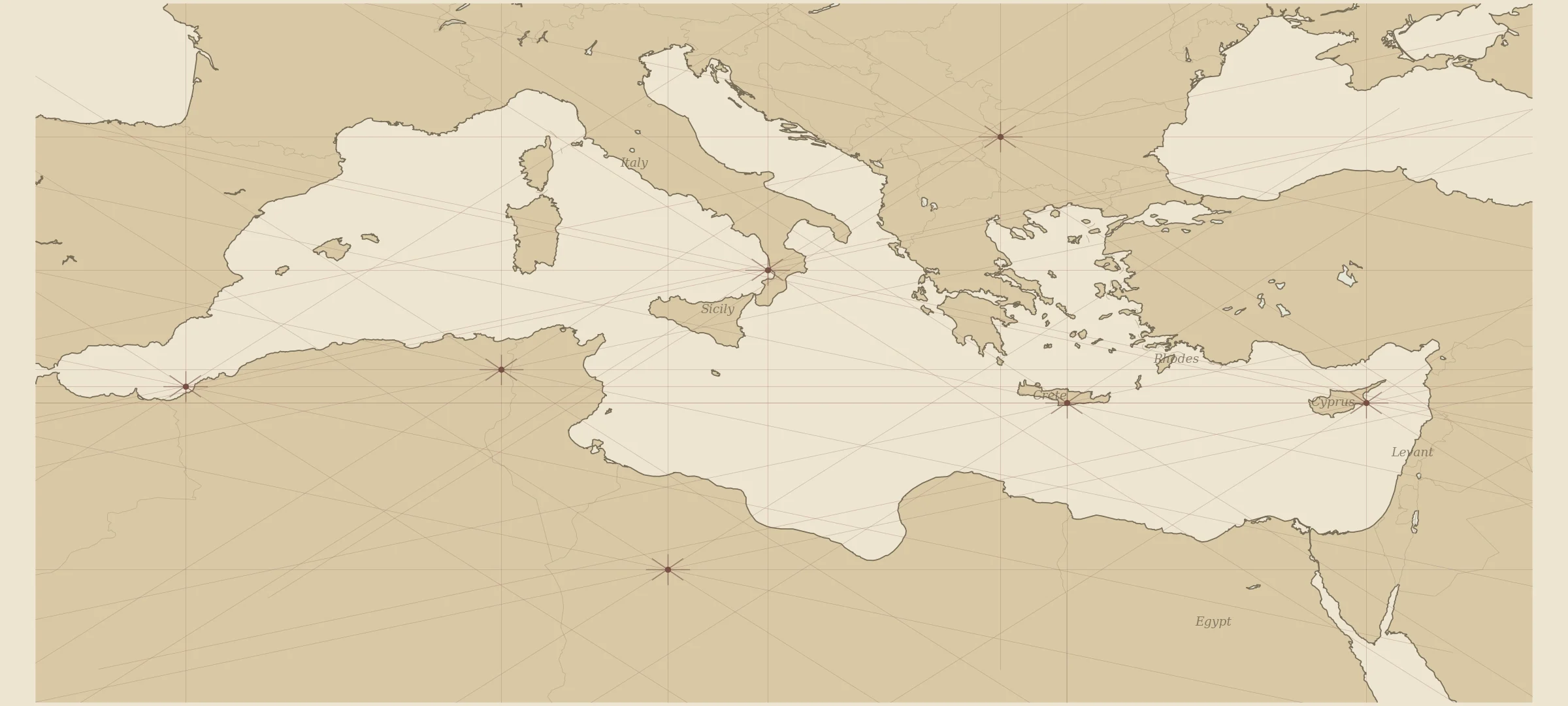
Choose a location on the map to compare textual perceptions, bodily experiences, fear, sounds, encounters and devotion. The larger passage inventory appears below.

Portolan-inspired modern reference geography of the Mediterranean basin. Pins mark present-day geographical reference locations, not precise historical itineraries.
Modern geographic control · period-inspired graphic
Local period-inspired modern Mediterranean reference graphic, not the historical portolan
Historical chart reference · separate source

The locally displayed picture is the modern reference map, not a facsimile of the ca. 1550 historical portolan. Follow the Library of Congress link to examine the separate historical chart; it has not been georeferenced for these pins.

Library of Congress source record ↗

The historical chart is accessed at the Library of Congress, not embedded or misrepresented by this local reference graphic.

A point identifies a modern reference coordinate or representative region. The underlying place mention, resolved historical identity, narrated encounter and experience are separate records. Lines and journey routes have not been invented.
02 — The comparison

A place, several experiences

The earlier 22 annotated examples remain intact. Browse a broader, source-linked layer of text-near-place suggestions, including Hebrew, Italian, French, Latin and English. Solid blocks are original expert-review examples; outlined blocks are unreviewed discovery cues, not calculated dramatic phases.

Evidence tier
Other ways to select a place · text controls
Or follow the experience across all places
Reading the ribbons
Stage → Move → Phase → Experience. Each band is ordered by source witness text order, not by an assumed route. Proposed candidate labels are purely lexical and have no Stage/Move/Phase adjudication. Length of a colored block does not represent duration, probability, intensity, or literary importance. Blank bands mean annotation is not yet available—not absence of experience.
04 — Corpus & evidence

Five travelers; source-controlled textual witnesses

Bartenura’s English travel-letter translation, Rinuccini’s Italian pilgrimage, Magno’s Italian and French editions, Fabri’s three Latin digital volumes, and Volterra’s Hebrew travel text are indexed at source-unit level. A separate scanned Fabri edition remains registered for subsequent facsimile alignment. The 22 existing examples are unchanged.

The earlier site’s Warsaw Hebrew Darkhei Zion, 1872 English excerpt and Magno Folger manuscript V.a.259 remain external comparative witnesses; they are not substituted for the uploaded 1992 English edition or other modern transcriptions.

What richer ribbons mean

Each passage can carry multiple proposed experiential categories: voiced fear or delight; sight; sound; physical discomfort; weather and bodily sensation; social encounter; devotional practice. Such words are evidence cues, not proof of narrator emotion. Speaker, intensity, irony, negation, reported experience and the place relation require review.

Magno’s Italian/French paired episodes are shown in dual-language panels. Hebrew Volterra is displayed right-to-left, with an independent place-indexed comparison to other writers. Cross-writer passages sharing a city are not translations of one another. Every quote links to its own source witness and original offsets.

Research-only access and reuse rights reported secured by the project. The site is not public and should be served only through identity-aware access. Source pages in the research ZIP can be opened from each passage; the standalone HTML shows the subset of bundled local facsimiles.

05 — Full-source reading

Every extractable passage remains in view

The ribbons are a review queue, not a replacement for the text. Search the full ingested Hebrew, Latin, Italian, French and English units and read any unit even if no experience cue was detected. PDF page numbers are file page indices, not necessarily printed folio numbers. Volterra’s logical RTL extraction is pending native transcription proofing.

Hebrew source witness · preserved from the previous site

Bartenura’s Darkhei Zion: the 1895 Warsaw edition

Eight episode-indexed folio views from the earlier website are retained as a separate Hebrew image witness, alongside the uploaded 1992 English translation. The older 1872 English selection derives from a different Hebrew textual witness. Thus these images offer episode-level comparison and palaeographic reading, not word-by-word translation alignment.

Scans recovered from the preceding self-contained research prototype; the complete Warsaw PDF is not in the present paper1.zip archive. Image correspondences and folio labels follow the previous site and require rechecking against the original volume.